
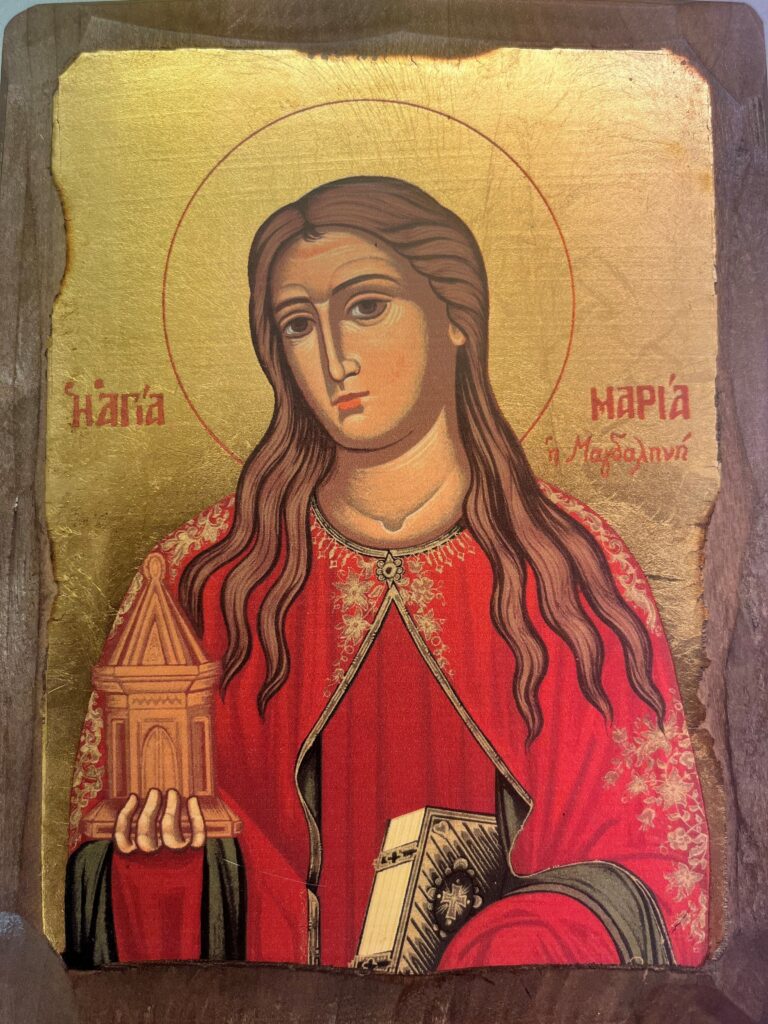
ST. MARY MAGDALENE

We live in a world of information overload. Data flies at us from every direction at an exponential rate. At Christmas dinner, when Uncle You-Know-Who makes a statement, Auntie I-Have-a-Smart-Phone can correct his mistakes with confidence and launch a quick query at Chat GPT. All facts can be checked. All arguments about dates and times and names resolved quickly. Except that we also live in a world where false data assaults us at an equally exponential rate. The term “fake news” is used to delegitimize real news and various forms of artificial intelligence are used to simulate and distort reality. It is an unprecedented reality.
Or is it?
Today’s saint might sympathize with our current woes and, perhaps, remind us that false information is nothing new to humankind. She has suffered a sullied reputation for most of Christian history – the victim of a failure to fact check. It was a pope who wrought the fake news – Gregory I in 591 CE. It was Mary Magdalene who suffered the consequences.
In one of his homilies, Pope Gregory had erroneously combined the story of Mary of Magdala with that of an unnamed woman in the Gospel of Luke who anointed Jesus’ feet (7:36-50) as well as the story from John’s Gospel (12:1-8) of a similar anointing by Mary of Bethany (the sister of Martha and Lazarus). With these stories, together with the one in which Jesus cast out seven demons from the Magdalene, began the tradition of depicting this faithful disciple as a prostitute. A scarlet letter was slapped on her back and, with the assistance of many artists throughout the ages, Mary of Magdala was given a new and false identity. (Further liberties continue to be taken with her story in our own time by fiction writers and filmmakers.)
What we do know about Mary is that she was a central member of Jesus’ troupe of disciples. She was born in a town called Magdala. She loved Jesus deeply and he loved her. She stood with Jesus’ mother Mary and the Beloved Disciple at the foot of the cross while Jesus died and wept at his tomb afterward. It was there in the early morning light that she was the very first person to encounter the Risen Christ. It was there that she became apostola apostolurum – the apostle to the apostles – the first to proclaim him risen from the dead. Her acclamation, “I have seen the Lord!” is one of the most poignant lines of scripture.
In 2016, Pope Francis established a feast day for Mary Magdalene on July 22. The decree establishing the feastnotes that this action was taken “in the current ecclesial context, which calls upon us to reflect more deeply on the dignity of women, the new evangelization, and the greatness of the mystery of divine mercy.” (Apostolorum apostola)
The story of Mary of Magdala is rich and beautiful – and even her false identity over the ages can be a lesson for us. Perhaps it is precisely this aspect of her story that has something to teach us today. It is a reminder to question people’s characterization of others, to check our facts and turn away from blind obedience and unquestioned authority. This side of heaven, we must bring a sense of healthy skepticism and wonder to all teachers, preachers, newsmakers and leaders. And, if you happen to be in the position of yourself being mis-represented, mixed up with another or unfairly maligned, then today’s saint might be the one for you.
Christine Way Skinner is a doctoral candidate at Regis St. Michael’s at the Toronto School of Theology and has been a lay pastoral minister for more than 30 years. Together with her husband, Michael, she has parented 6 wonderful children. She has written a number of books for Novalis on living the Catholic faith for both adults and children.
Very timely. We need people like you to keep us on track