LEARNING TO SEE WITH ST. IGNATIUS: DISCOVERING GOD’S PRESENCE IN THE ORDINARY

We celebrate the feast of St. Ignatius of Loyola on July 31. This soldier-turned-saint has had a profound influence on the Catholic Church since his death in 1556, during the Catholic response to the Reformation, through his founding of the Society of Jesus, his Spiritual Exercises, and his vision of finding God in all things. He profoundly shaped Catholic spirituality, prayer, discernment, education, leadership, mission and social engagement by teaching people to seek, find and serve God in all things. It is impossible to do justice to his extensive contributions in a relatively brief blog post, so we will focus on one foundational idea that can resonate with all of us: learning to see.
Ignatius encourages us to see God in common, everyday experiences. His close collaborator, Jerónimo Nadal, summarized the Ignatian approach in this way: “We should notice God present in all things.” Attentiveness to these glimpses of the sacred can be a way of living out the Gospel call from Luke 18:1 to “pray always.” Performing daily tasks with an awareness of the sacred nurtures our spirituality and connects us to God.
While making breakfast, we can thank God for our daily bread. While driving to work, we can pray for those we encounter, reminding ourselves that every person is loved by God. While answering emails, we can reflect on our connection with others while practicing honesty, kindness and respect. For those who teach and catechize, we can consider how we participate in Christ’s mission of revealing truth and nurturing faith.
We are invited to see the world through sacred lenses. One of these lenses is gratitude, which Ignatius places at the beginning of the Daily Examen: “The first point is to give thanks to God our Lord for the benefits received.” —Spiritual Exercises, 43.
Seeing the world with grateful eyes is deeply connected to the language of grace. Both words come from the same Latin family of words associated with gift, favour, and thanksgiving. Gratitude helps us recognize grace already present in our lives. Are we open to receiving God’s grace in the small events of our daily experience? Here St. Ignatius resonates with St. Thérèse of Lisieux, whose “little way” invited people to discover God’s love in ordinary moments through trust, gratitude and loving action.
Seeing the world with grateful eyes is deeply connected to the language of grace. Both words come from the same Latin family of words associated with gift, favour and thanksgiving. Gratitude helps us recognize grace already present in our lives. Are we open to receiving God’s grace in the small events of our daily experience? Here St. Ignatius resonates with St. Thérèse of Lisieux, whose “little way” invited people to discover God’s love in ordinary moments through trust, gratitude and loving action.
When we turn our seeing inward through the lens of discernment, Ignatius echoes St. Augustine’s reflection on the restless heart. Our hearts are always moving. Ignatius invites us to notice these movements by asking:
- What gives life?
- What drains life?
- What brings peace?
- What leaves me restless?
Like contemplating waves rolling onto the shore, we learn to observe the movements of our hearts with gracious and compassionate eyes, discerning where God may be leading us.
Ignatius also invites us to see scripture with the eyes of imagination. Rather than simply reading about Jesus, he encourages us to enter the Gospel scenes using all our senses: to hear the sounds, smell the sea, stand among the crowds, notice the expressions of those present, and listen as Christ speaks. This imaginative vision helps us recognize Christ not only in scripture but also in contemporary settings.
Artists and saints share a similar discipline: they learn to pay attention. An artist looks patiently at ordinary things until hidden beauty appears. St. Ignatius invites us to do the same with our lives – to notice where God is present, where grace is moving, and where love is calling us. Grace-filled seeing is not about looking at the world differently; it is about learning to see more deeply.
There is good reason to suggest St. Ignatius as a spiritual patron of Visio Divina. Praying with art through Visio Divina teaches us to look with the eyes of faith. St. Ignatius belongs among its spiritual guides because his entire life was devoted to recognizing God’s presence in Scripture, in creation, in others, and in the ordinary moments of daily life.
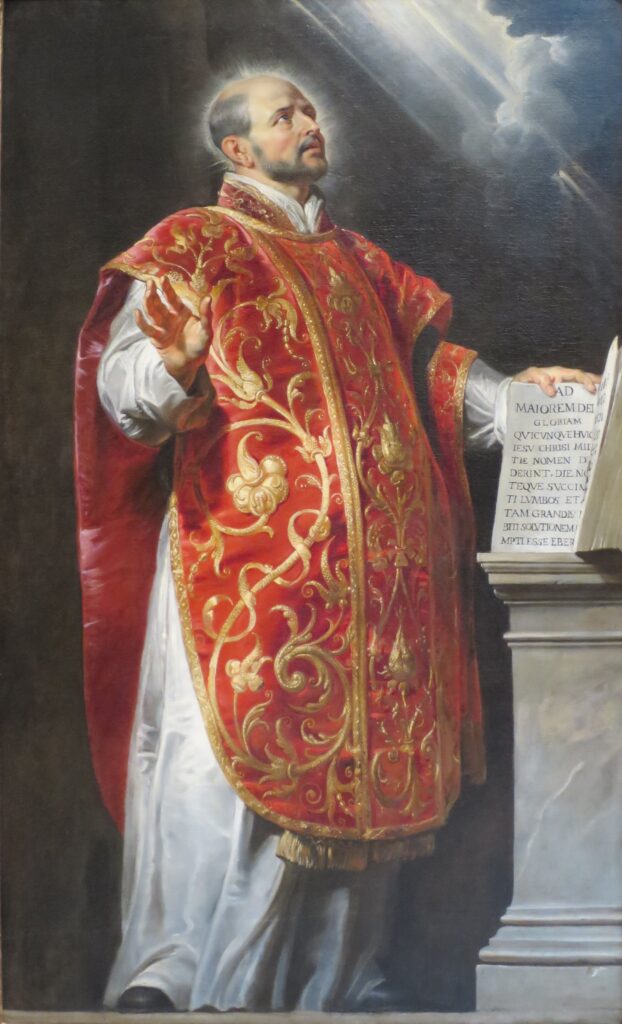
So let us contemplate Rubens’ image of St. Ignatius of Loyola (above).
Rubens presents a saint whose eyes have been transformed by grace. He teaches us that Christian vision is more than seeing what is before us; it is learning to recognize the hidden presence of God within and beyond what we see. Like Ignatius, we are invited to become people whose eyes are opened – to see creation as gift, others as beloved, and every moment as a place where God can be encountered.
St. Ignatius did not ask us to look for extraordinary visions. He taught us to see the ordinary world with renewed eyes. The miracle is not that God occasionally breaks into our lives, but that God has been present all along, waiting for us to notice.
Les Miller is a devoted husband, father, grandfather, and catechist who has served the Catholic education community in various roles since 1980. An accomplished author, he wrote the 25 Questions Series as well as the award-winning books Catholic Teacher’s Companion and Northern Light. Alongside co-author Lisa Freemantle, he also created the Words for the Journey series of prayers and prayer services. Today, Les shares his extensive experience as a facilitator for the Archdiocese of Toronto’s catechist formation program and as a frequent presenter in local schools and parishes.