ST. JOSEPH, THE WORKER

St. Joseph is the Swiss army knife of saints. Over the centuries he has accumulated many duties as patron of various people and things: Canada, unborn children, fathers, travellers, immigrants, even real estate agents, and the Universal Church, to name a few.
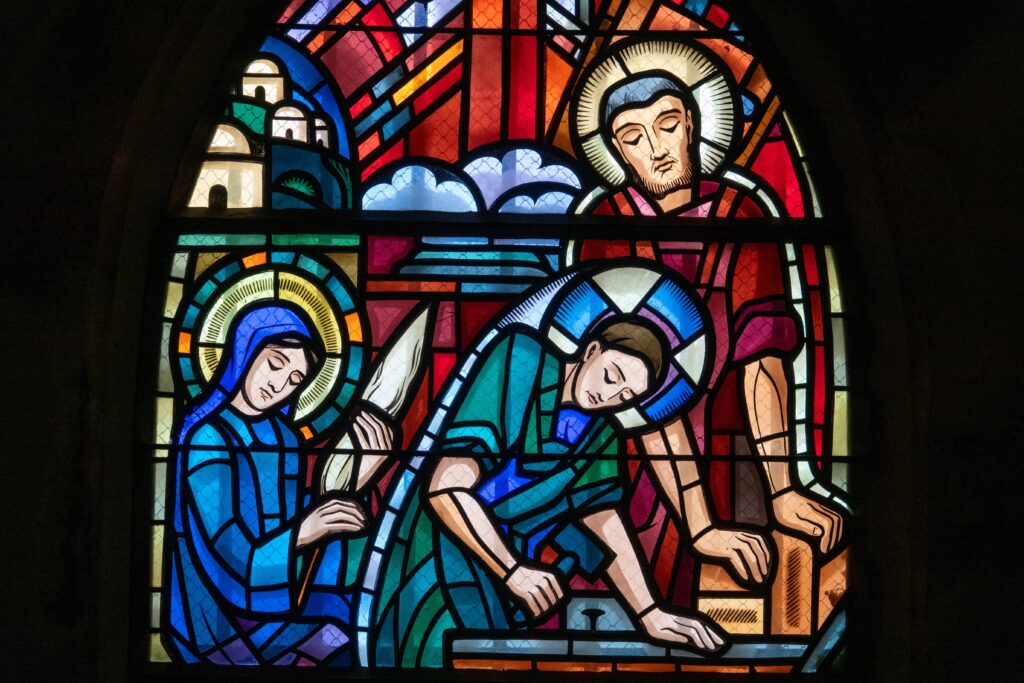
And, of course, workers. On May 1 we celebrate the feast of St. Joseph the Worker. Joseph is an ideal patron, himself having been a carpenter by trade, a person used to hard labour and working with his hands, used to supporting a family, used to shouldering responsibility.
However, though dedicated to St. Joseph, the point of this particular feast is to underline the importance of human labour and those who perform it. Pope Pius XII instituted this feast in 1955 as a Christian counter to the May Day celebrations organized by Communists. It is meant to underline how the Church celebrates the dignity of work and sees it as a way to participate in God’s creation.
St. Pope John Paul II, in his encyclical Laborem Exercens, affirmed that the Church “considers it her task always to call attention to the dignity and rights of those who work, to condemn situations in which that dignity and those rights are violated, and to help to guide social changes so as to ensure authentic progress by man and society.”
In fact, with the rapid evolution of artificial intelligence (AI), the notion of human labour takes on special significance. Though more is unknown than known with any certainty about what impact AI will actually have on human society, there is growing evidence that it will displace large numbers of what have been called “information workers,” those whose skills in modern technology was once thought to guarantee jobs for life. Increasingly, the headlines are full of stories of large corporations racing to replace humans with software. What will these people do to support themselves and their families? And what becomes of the value of their creative endeavours if they can be replicated in seconds by machines?
In one of the first speeches of his papacy, on May 12, 2025, Pope Leo XIV addressed the world’s journalists, highlighting AI, recognizing its potential for good, but also warning that it will need to be managed responsibly “so that it can be used for the good of all, so that it can benefit all of humanity.”
The Church recognizes that work, whether paid or unpaid, is an essential ingredient in our human dignity. Far from being mere drudgery, human labour can be thought of as a way to contribute to the common good, to demonstrate our shared responsibility for the well-being of the planet and all of God’s creation on it. It can rightly be called holy.
O Glorious Saint Joseph, model of all those who are devoted to labour,
obtain for me the grace to work in a spirit of penance for the expiation of my many sins;
to work conscientiously, putting the call of duty above my natural inclinations;
to work with thankfulness and joy, considering it an honour to employ and develop by means of labour the gifts received from God;
to work with order, peace, moderation, and patience, never shrinking from weariness and trials….
All for Jesus, all through Mary, all after thy example, O Patriarch, Saint Joseph.
Such shall be my watch-word in life and in death. Amen.
(excerpted from prayer written by Pope Pius X)
Joseph Sinasac is a retired Publishing Director of Novalis Publishing. He has been involved with religious communications for almost 45 years as an author, journalist, editor and TV and radio commentator on all things Catholic.