TRINITY: RELATIONSHIP AT THE HEART OF CREATION

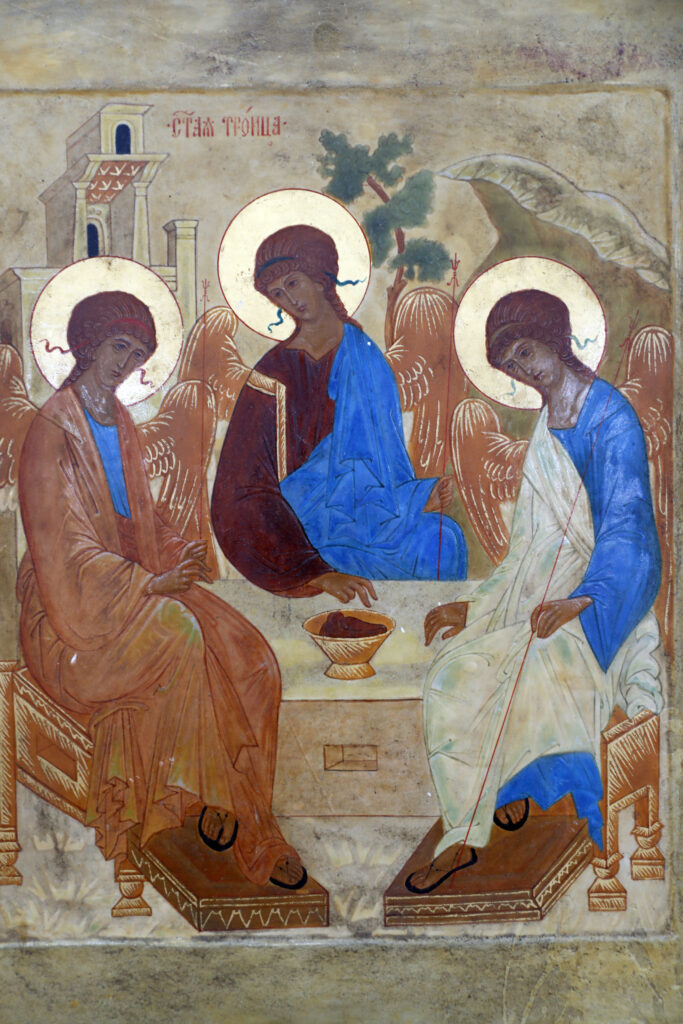
Many years ago, I listened to academic paper on the Trinity. The presenter was clearly brilliant but I’m pretty sure I only grasped about 2% of what he was saying. As he discussed the relation of the Father to the Son and how the Spirit proceeds from the Father and the Son, and what is the exact nature of the relationship between the three persons in one, all important theological questions, I kept thinking… but what difference does all of this mean in my life? How does it impact my day-to-day living?
I was not surprised a few weeks later, then, to discover the German theologian Karl Rahner (1904–1984) lamenting that while Christians do not consciously deny the Trinity, it seems to be of little relevance to most of them. Indeed, he says, “the doctrine of the Trinity has become so irrelevant to people that I suspect that if the powers on high were to declare that there is now a fourth person in the godhead, the people’s response would be, ‘Oh, here they come with another change.’ And then then they would go about their day without it taking up much more of their mental bandwith.”
But it has not been dropped and for that I am grateful. Indeed, the doctrine of the Trinity not only matters, but is profound, beautiful and worthy of our contemplation.
The Trinity is one of the notions that all Christians share and, indeed, is considered by most to be a central doctrine our common faith. We who are Christian, claim that we are made in the very image and likeness of God and that God is a Trinity of persons. Such a concept of God places loving relationship at the very centre of what it means to be human.
This means that we were not made for the division that so plagues us… but for it’s very opposite. We were made to be as God is … in loving communion. A relationship which does not annihilate the diversity of persons – Father, Son and Spirit – Creator, Redeemer and Sanctifier – but rather abides, through love, in a perfect unity.
This matters. It matters because the only real solution to the disconnect that we experience from God, from the planet, from other people and, even, from our own true selves, is to learn how to be in loving relationship… a loving relationship which does not annihilate the other, forcing it to be like ourselves, but which loves the other in all its “otherness.”
William Paul Young – author of The Shack – describes relationship as a “wild card.” He says, for instance, that “Marriage would be so much easier if there wasn’t another person involved. Marriage would be so much easier, but then,” of course, “it would be meaningless, too.” So much of the chaos that humans contend with – war, poverty, violence, betrayal – is a failure to be in right relationship. It is a failure to embrace the other person as truly unique and different from us but beloved all the same. It is our failure to appreciate the very necessary gifts of all that keeps us from living in peace.
And while it is true that Trinitarian communion is at the heart of human community, it is also at the heart of all creation. We need the gift of the trees and the foxes and the earthworms. We are dependent on the oceans and the grasses and the trilliums. And they are also dependent on our loving care and on one another. All of creation, including but not exclusively God’s human creatures, reflect the miraculous wonder of its loving, relational Trinitarian Creator.
Christine Way Skinner is a doctoral student at Regis St. Michael’s at the Toronto School of Theology and has been a lay pastoral minister for more than 30 years. Together with her husband, Michael, she has parented 6 wonderful children. She has written a number of books for Novalis on living the Catholic faith for both adults and children.