ST PAUL OF THE CROSS

“If you build it, he will come,” a disembodied voice speaks to the Iowa farmer that plays the main character in the movie Field of Dreams (1989). This phrase became an often-repeated motto (though transformed to “they will come”) by people encouraging others to begin building the project, establishing the enterprise or creating the world that they wanted. It promised the certainly that an act begun in such hope would eventually attract the necessary collaborators.
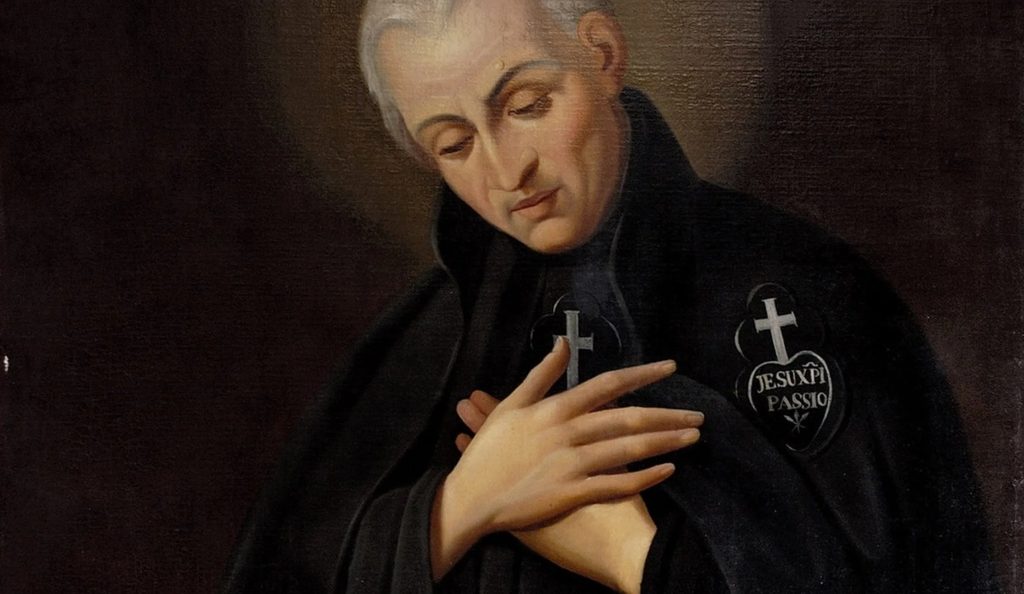
Well, St. Paul of the Cross, didn’t need to watch the movie (or read Canadian author W.P. Kinsella’s novel Shoeless Joe upon which the movie was inspired) to be inspired for a similar effort. At the age of 26, in the early 1700s in northern Italy, Paolo Francesco Danei began to write a rule for a religious community which had exactly one member – himself. The community rule emphasized a life of penance, poverty and mediation on the Passion of Jesus. Its mission was to serve the poor – whomever that might be. Soon Paolo was joined by his brother John Baptist. It was a start. An optimist might say the population doubled in no time! The brothers moved to Rome where they were invited to care for hospital patients. There they studied a little theology, were ordained to the priesthood (by the Pope no less) and began lives of preaching in the remote areas of the country.
“If you build it, they will come.” Especially if you are a gifted preacher. Within ten years, the brothers had collected a small group of companions. They now numbered nine. It was an austere life. Nothing as attractive as a baseball field full of sports fans. But enough people to found an order. They called themselves the Passionists and added a fourth vow to the traditional (poverty, chastity and obedience). This was a vow to teach people about the suffering and death of Jesus – his Passion.
Paolo wasn’t interested in spectacle. But he was authentic and his focus on Christ’s passion spoke to many, many people even if they were unable to adopt his way of life. Life was difficult for people in the 1700s. Paolo’s own family had to move often for his parents to make enough to feed their children. Of the sixteen children his mother bore, only six survived to adulthood. He knew suffering. And he found comfort in a God who loved humanity with a greatness manifest by a willingness to enter into the created world and endure the depths of human suffering. So, too, did all those who came to hear Paolo preach find comfort in a Divine love that great.
As followers of the Christ who loved us so much that he was willing to suffer and die, we are called to also be self-giving and self-sacrificing. Those who follow Christ can expect to suffer for their faith. It may be the suffering of being subjected to disrespect for our beliefs. It may be the suffering of opposition to our work on behalf of the marginalized or of our truth-telling. It may, if we live in some parts of the world, be actual martyrdom.
By the time Paolo died in 1775, there were 180 priests and brothers in the Passionist community. Today they number over two thousand. The memorial of St. Paul of the Cross is celebrated on October 19.
St. Paul of the Cross, pray for us!
Christine Way Skinner is a doctoral candidate at Regis St. Michael’s at the Toronto School of Theology and has been a lay pastoral minister for more than 30 years. Together with her husband, Michael, she has parented 6 wonderful children. She has written a number of books for Novalis on living the Catholic faith for both adults and children.