THOMAS, THE DOUBTING TWIN

Today we celebrate the feast of St. Thomas the Apostle, also known as doubting Thomas. I certainly identify with him in my struggles to understand our faith. How can I believe in a resurrection when my biology tells me that when you are dead, you are dead? How can I believe in the power of prayer when it is beyond sight and sound? How can I take moral advice from a Church when so many other voices are telling me that we are wrong and misguided? And yet, I remain and I believe but it is a struggle! As I move from doubting Les to believing Les, I turn to St. Thomas as a prayer companion.
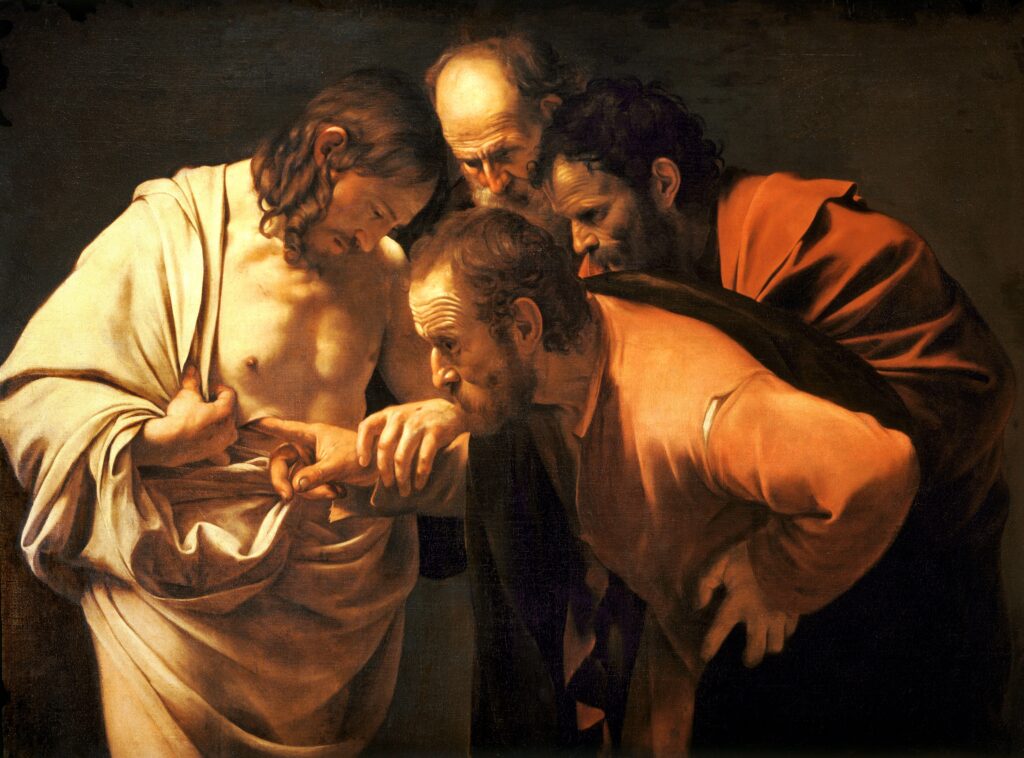
Let’s pray a Visio Divina of Caravaggio’s painting of The Incredulity of Thomas that depicts the passage in John’s Gospel.
(1) Make a sign of the cross. Attend to the image while stilling yourself from distractions. Take in the whole scene… the lighting… the colours… the shapes of the figures. Look at each face in turn, noting their expressions. What are they thinking? Look at the hand of Thomas in the side of Jesus. Note your various emotional, intellectual and spiritual reactions.
(2) Read the passage from John’s Gospel 20:24-29:
But Thomas (who was called the Twin, one of the twelve, was not with them when Jesus came. So the other disciples told him, “We have seen the Lord.” But he said to them, “Unless I see the mark of the nails in his hands, and put my finger in the mark of the nails and my hand in his side, I will not believe.”
A week later his disciples were again in the house, and Thomas was with them. Although the doors were shut, Jesus came and stood among them and said, “Peace be with you.” Then he said to Thomas, “Put your finger here and see my hands. Reach out your hand and put it in my side. Do not doubt but believe.” Thomas answered him, “My Lord and my God!” Jesus said to him, “Have you believed because you have seen me? Blessed are those who have not seen and yet have come to believe.”
(3) What words or phrases stand out for you? Having read the passage in context of the art, what insights about the passage do you have? How is the sacred present in this prayer? Share these ideas with a companion or write them in your prayer journal.
(4) Consider and pray on these insights:
Thomas leans forward as Caravaggio captures the moment when Thomas truly sees and is about to say, “My Lord and my God.” This transition is supported by the other disciples also leaning in and the dark cloak falling away from Thomas. What are those moments in our lives when we recognize Jesus in the everyday and say, “My Lord and my God?” Jesus is guiding the hand of Thomas. Do I let Jesus guide my hand to see through the eyes of faith?
Thomas moves from data-driven assessment to a larger faith perspective. Caravaggio depicts this moment of conversion in which Thomas embraces the deeper reality of reason which is wrapped in faith. Thomas is our twin in confronting the problems posed by access to technology and artificial intelligence.
In his recent Encyclical, Magnifica Humanitas: On Safeguarding the Human Person in the Time of Artificial Intelligence, Pope Leo XIV points to the limitations of what Canadian philosopher Charles Taylor calls instrumental reason. This “means-ends” mindset focuses only on the quickest, cheapest and most efficient way to achieve a goal over moral standards or the dignity of the human person. Yes, we need to think instrumentally when we are repairing a car but life is more than a series of problems to be fixed. Gabriel Marcel tells us that it is a mystery to be celebrated. As Thomas moves from instrumental reason that causes him to doubt to a faith-infused view that allows him to experience the deeper truth.
Thomas bends over, taking the shape of a question mark. This is Thomas who had asked at the Last Supper, “How can we know the way? (John 14:5)” This is Thomas whose questioning has led him back to the Upper Room. This is Thomas, whose path to faith is paved with questions.
(5) Abide in the goodness, truth and beauty of this image. Rest and pray. Allow sacred presence to wash over you.
(6) As we end our prayer, let us consider these questions: Where did we encounter God in this prayer? How are we Thomas’ twin? What are our questions? For what are we grateful? Record these insights in a journal or discuss them with a partner.
Let’s meditate on Thomas as our twin on his feast day. His question is fundamentally “how can it be?” Jesus’ response is “let me guide your hand, let me guide your life.”
Les Miller is a husband, dad, grandfather and catechist. He has served the Catholic education community for 40 years as teacher, chaplaincy team leader, Department Head. AQ Instructor, textbook writer, and Religious Education and Family Life Consultant. Les authored the 25 Questions Series, Words for the Journey and award-winners Catholic Teacher’s Companion and Northern Light. Currently, he is an instructor and advisor with the Archdiocese of Toronto’s online Catechist formation program and lead contributor to the St. Monica Institute’s series on praying with art, Abide in Beauty.