WORLD DAY FOR MIGRANTS AND REFUGEES: ANGELS UNAWARES

I came to Canada in 1965 as a migrant. My reception in Sydney, Nova Scotia, was affirming and welcoming. Why not? I was a 12-year-old with a Northern English accent at the height of Beatlemania.
Many migrants have not been so fortunate. Any decision to leave home because of social, economic or political pressures involves loss. We leave behind familiar landscapes, family and friends, customs and communities. There can be a profound sense of loss that stays with migrants, even those of us whose immigrant experience was relatively benign.
It is not that we aren’t grateful for our new home. Canada became home for me, as it has for so many migrants. But gratitude does not erase what has been left behind. Loss and gratitude can live together. So can loss and hope.
I vividly remember sailing up the St. Lawrence River toward Quebec City, the autumn colours glowing along the shore. Somewhere ahead was a new country, a new home and a new life. I had no idea what any of them would look like. But for a 12-year-old boy standing on the deck of a ship, that unknown world was filled with possibility. Perhaps that memory is one reason I was so drawn, many years later, to another boat filled with people on a journey toward an uncertain future.
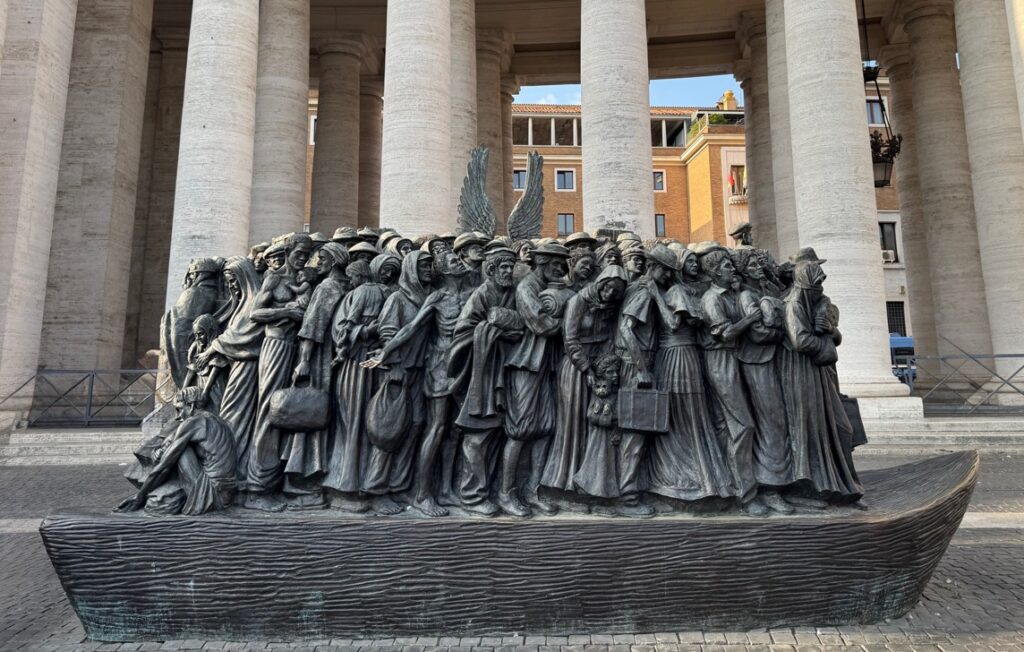
Angels Unawares has a special connection with the World Day of Migrants and Refugees. It was on September 29, 2019, that Pope Francis unveiled this life-sized bronze and clay piece by Canadian sculptor Timothy Schmalz in St. Peter’s Square. Schmalz gathered migrants and refugees from different cultures and periods of history into a single crowded boat, reminding us that migration is not simply an issue of our own time but part of the human story. Pope Francis wanted the sculpture placed permanently in the square as a reminder of the Gospel call to welcome the stranger. For Schmalz, whose art seeks to awaken compassion, the figures are more than migrants to be observed. The angel wings rising unexpectedly from their midst invite us to look again and recognize something sacred among them.
Every work of art has a frame, whether explicit or implied. For Angels Unawares, that frame is St. Peter’s Square itself – an architecture of holiness. Bernini’s great colonnade reaches out in a welcoming embrace. Above, the saints look down from the colonnade; below, migrants and refugees crowd together in Schmalz’s boat. Behind them rises St. Peter’s Basilica, at the heart of the Catholic Church’s liturgical life. The setting becomes part of the sculpture. Saints above. Migrants below. The Church embracing them. Here, those so often pushed to the margins have been placed at the centre of one of the most sacred spaces in the Catholic world.
At first, you see the whole thing: a boat overflowing with humanity. Crowded together are 140 people from different cultures and different moments in history. Some are refugees fleeing persecution and war. Others are migrants searching for security and a better life for their families. Together they represent centuries of human migration.
When I photographed Angels Unawares, I began, naturally enough, with the whole sculpture. But the longer I walked around it, the closer I came. The boat became faces. The faces became families. Small details began to emerge.
Schmalz wants us to do more than admire his sculpture. He wants us to see. He has spoken about the ability of art to create awareness in a subtle and beautiful way. Much of his work focuses our attention on people whom society can easily overlook: migrants and refugees, people experiencing homelessness, victims of human trafficking. His sculptures ask us to notice people who can become invisible.
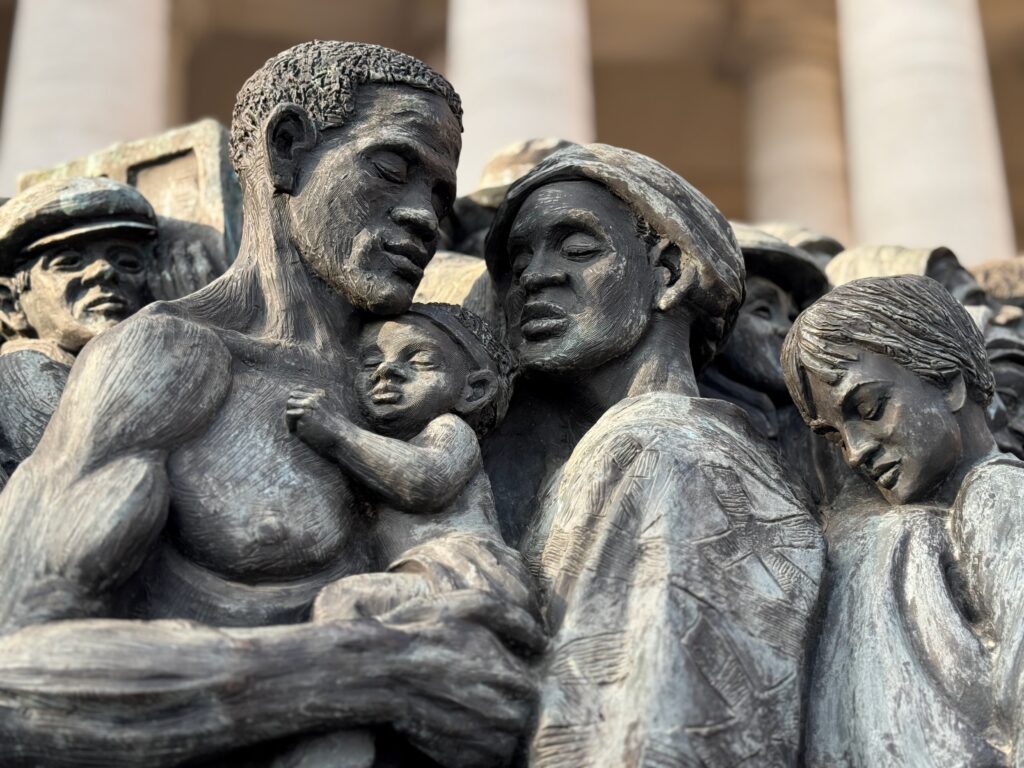
Look at the faces. As we move closer, the crowd ceases to be a mass of migrants and becomes a collection of human stories. A mother. A father. A sleeping child. We don’t know their story, but perhaps we recognize something of our own story in theirs: love of family, anxiety about the future, the desire to protect our children and the hope of finding a place where they can flourish.
This is one of the great strengths of Angels Unawares. Schmalz does not allow the migrant to remain an abstraction. Migration has a face. Almost all of us have been touched by migration in one way or another. Country to country. Rural to urban. Family home to a new home. Migration is part of the human story.
It is also part of our biblical story. Abraham and Sarah leave their homeland without knowing where their journey will lead. The Israelites become strangers in Egypt. Ruth leaves her people to make a home among strangers. Mary and Joseph flee to Egypt with the infant Jesus.
Again and again, Scripture asks us to see the stranger differently. Not as a problem. Not as a statistic. As a person. But Angels Unawares asks something more of us.
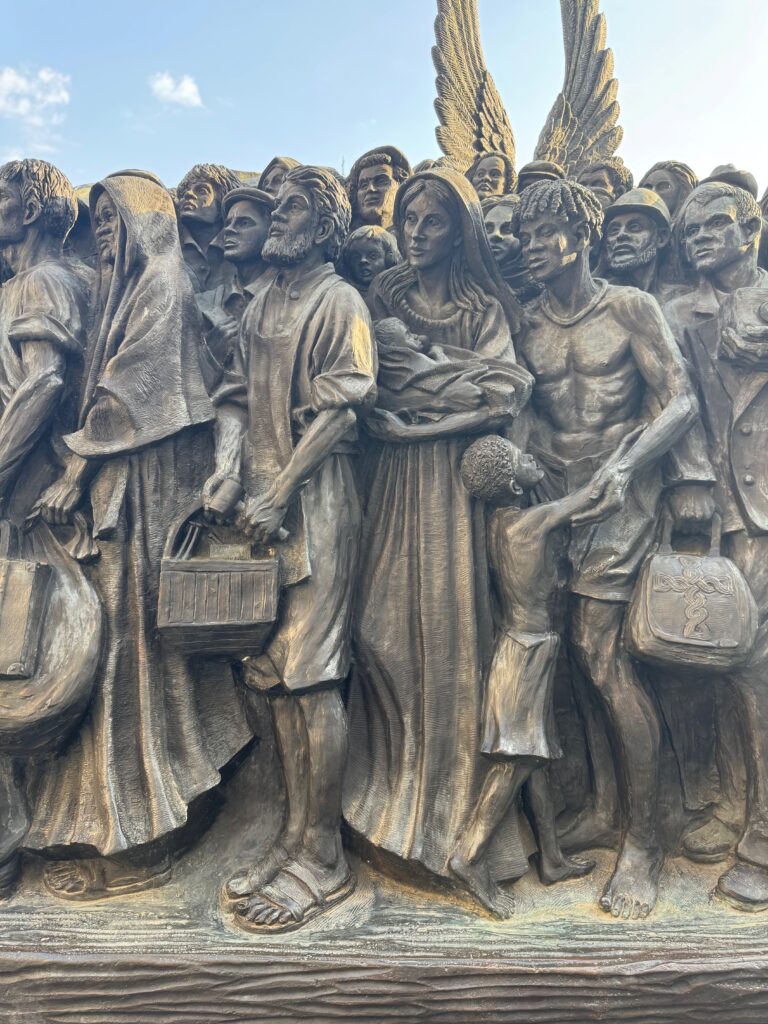
Look again. Above the crowded figures rise two great wings. At first, they can almost disappear among the mass of people. Once we notice them, however, they change the way we see everyone in the boat. Something sacred is present among them. The stranger is no longer simply someone whom we are called to help. The stranger may also bring something of God to us. That changes the way we look at the sculpture.
And perhaps it changes the way we look at migrants. To see differently is the beginning of conversion. The wings point us toward the passage from the Letter to the Hebrews that gives Schmalz’s sculpture its name: “Do not neglect to show hospitality to strangers, for by doing that some have entertained angels without knowing it” (Hebrews 13:2).
There are other things we notice only when we get close.
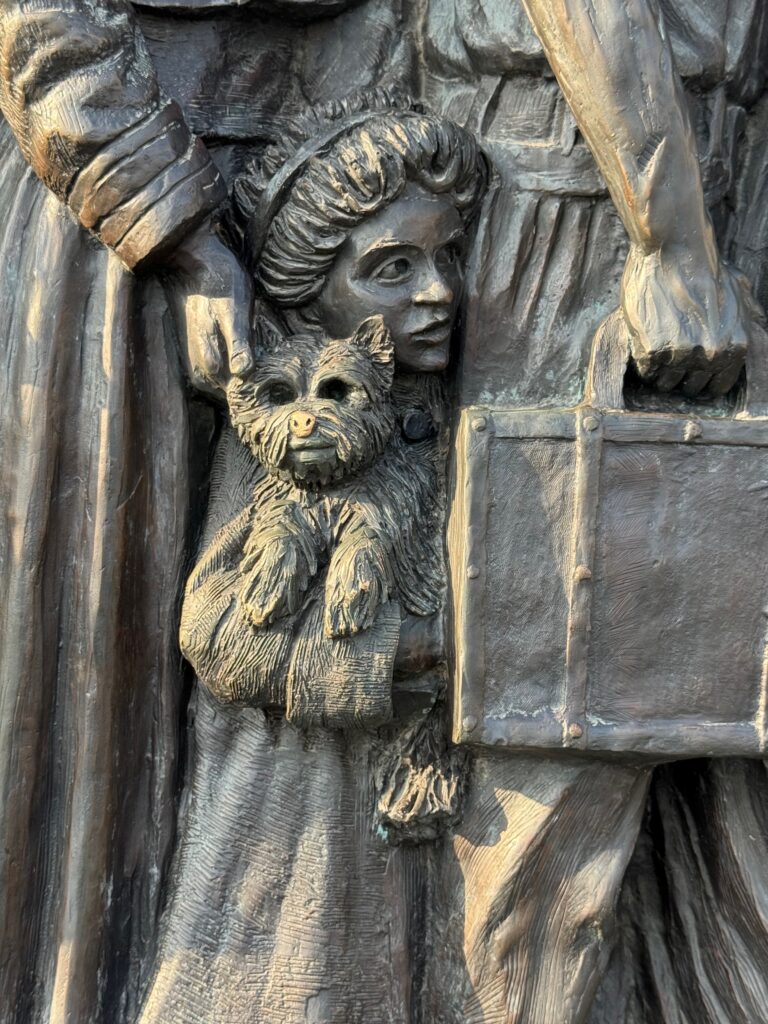
Between the adults, a child peers out, holding a small dog. It is such a tiny detail in such an enormous sculpture. It would be easy to walk past without noticing it. Yet perhaps that is precisely the point.
People do not migrate as abstractions. They leave homes and neighbourhoods, friends and grandparents, schools and workplaces. They carry whatever pieces of home they can take with them: a suitcase, a treasured possession, perhaps even a beloved animal. In the microcosm is the macrocosm. In one child and one small dog we glimpse something of the enormous human experience of leaving home.
But Schmalz also invites us to find ourselves among the people in the boat. We may never have crossed an ocean as migrants or fled our homes as refugees, but all of us know something about leaving one place and entering another. We live in the wake of the great migrations that transformed our societies as generations moved from countryside to cities. And we experience our own personal migrations – from childhood to adulthood, from one home to another, through relationships gained and lost, through the different seasons of our lives.
Perhaps the angel rising from Schmalz’s boat does more than reveal the holiness of the migrant. Perhaps it consecrates the journey itself. And that raises a question for each of us: How do we consecrate our own migrations? How might the journeys of our lives become pilgrimages?
Perhaps helping people make that discovery is part of the vocation of all who minister in the Church. Whether we are catechists, teachers, artists, musicians or ministers of hospitality and outreach, part of our work is to help people see – to notice what might otherwise remain unnoticed and to recognize the presence of God in unexpected places.
Schmalz does this through bronze. He teaches us to look beyond the category of “migrant” and see the person, the family, the story. Then he asks us to look again. He teaches us to see the holy in the midst of migrants.
On the World Day of Migrants and Refugees, we are reminded that each of us is called to practise a ministry of hospitality. Pope Francis summarized our responsibilities toward migrants and refugees in four simple verbs: welcome, protect, promote and integrate.
Consider the first: Welcome. Someone welcomed me to Canada in 1965. Kind people welcomed a 12-year-old boy with a Northern English accent who had sailed up the St. Lawrence toward an unknown home.
Today, someone else is making that journey. Someone is leaving behind a familiar landscape. Someone is saying goodbye to family and friends. Someone is carrying loss. Someone is carrying hope. Someone is looking for a place to call home.
Schmalz asks us to look. Faith asks us to see the holy. Missionary discipleship calls us to respond. Look carefully. There may be angels among us.
Les Miller is a devoted husband, father, grandfather, and catechist who has served the Catholic education community in various roles since 1980. An accomplished author, he wrote the 25 Questions Series as well as the award-winning books Catholic Teacher’s Companion and Northern Light. Alongside co-author Lisa Freemantle, he also created the Words for the Journey series of prayers and prayer services. Today, Les shares his extensive experience as a facilitator for the Archdiocese of Toronto’s catechist formation program and as a frequent presenter in local schools and parishes.